 | Between the United States and Germany 1945-1954 |
| | Between the United States and Germany 1945-1954 |
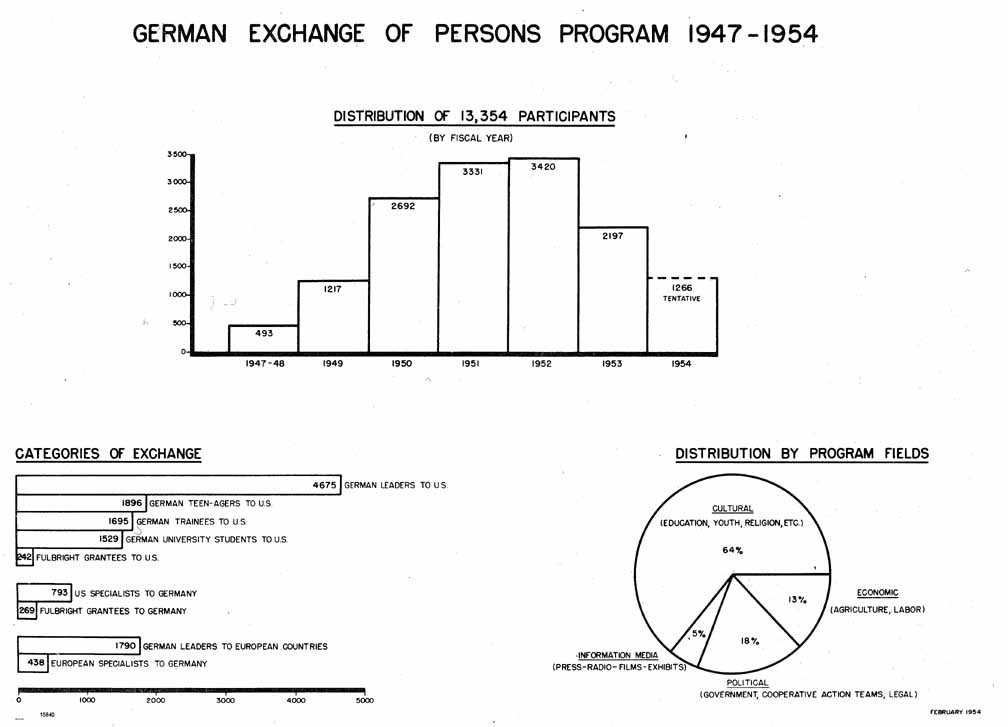
In the history of educational, cultural, and intellectual relations between the United States and other nations of the world, few events have been more dramatic or more significant than the educational and cultural program between the United States and Germany in the immediate post-World War II decade. During that period, more than 12,000 Germans and 2,000 Americans participated in what was the largest educational and cultural exchange program with another country that has ever been undertaken by the U.S. Government.
The present educational and cultural exchanges carried out between the two countries that are funded by the U.S. Government are modest compared with their earlier, immediate postwar dimensions. In 1966, the American Ambassador to Germany, George C. McGhee, wrote to Charles Frankel, Assistant Secretary for Educational and Cultural Affairs in the Department: "Our international visitor program has declined to a level which no longer bears meaningful relation to the number of actual and potential leaders in this country . . . For the first time in the postwar era new leaders are assuming office in Germany on national and state levels . . . German-American relations are entering a new phase. We should in fact be increasing rather than decreasing the size of our exchange program in order to make certain that knowledge of America and American viewpoints remain important ingredients in the experience of the coming generation of German leaders."(1)
Beginning in 1956 the program was funded from a single annual Congressional appropriation to support exchange programs with over 100 countries throughout the world. The number of exchanges between the two countries was gradually reduced to the level of exchanges with other major countries. By 1975 the annual number of participants had shrunk to a fraction (463) of the peak total in 1952 (3,415).
But the program has grown in other ways. In contrast to the earlier years, a large part of the funding is now from German sources. One of the most conclusive evidences of German official recognition of the cultural factor in consolidating bilateral relations between the Federal Republic and the United States has been the increasing share of financial responsibility assumed by Germany for exchanges under the binationally administered Fulbright program. In 1962 Germany agreed to underwrite 50 percent of the budget. By 1975 it carried two-thirds ($1,699,000) of the total expenditure ($2,555,000). In various other related exchange activities, the financial contribution of the German government to the furtherance of closer cultural relations between the two countries now surpasses that of our own government.
Efforts on both the American and German sides to improve and refine the program continue. The problems that exist in the exchange program are the subject of continuing dialogue between the two governments, and both are in full agreement in their cooperative approach in evaluating them. One of these problems yet to be solved, for example, is the establishment of equivalence of academic curricula, examinations and degrees.(2) Another is that of greater participation of critical and social groups which represent significant trends in the national life of both countries. Still another is that of promoting the cooperation of scholars in fields of long-range international interest that constitute the paramount challenges of today's interdependent world, and which, because of their universality, reflect significant concerns in the national life of both countries.
Aside from the immediate postwar "educational reorientation" aspects of the late forties and early fifties, the basic objectives of the program remain unchanged: to enable each country to present an adequate image of its cultural achievements and to foster fruitful exchanges in the cause of mutual understanding. Mutual understanding is a complex, long-term task. Although relations between the two countries, to be sure, are excellent, stereotypes linger on on both sides of the Atlantic. A persistent effort is required to correct misconceptions and image distortions. Former Chancellor Willi Brandt probably thought along these terms when he said: "We shall have to devote time and effort to each other. We must get to know each other better, still more we must learn to live with each other. More young Europeans must have the opportunity of exploring the social landscape of America, of discovering America's outlook on life, of becoming familiar with its history, and the process must be reciprocal. In this we cannot put our faith in governments alone."(3) The HICOG program laid the foundation for this kind of approach. It has lost none of its validity.
Among the more recent expressions of German appreciation of American efforts to build up this relationship have been "The German Marshall Fund of the United States" for which the Federal Republic provided 150 million Deutschmarks, starting in June 1972, and the "John J. McCloy Fund for German-American Exchanges," established in 1975.
The formation of the German Marshall Fund was announced by Chancellor Willi Brandt at a special convocation at Harvard University, on June 5, 1972. In his remarks on the occasion, the German Chancellor stated:
"On the occasion of the 25th anniversary of the announcement of the European Recovery Program by Secretary of State George Marshall, we, my colleagues representing all parties of our Parliament, and I, wish to inform you of several measures taken by the Federal Republic of Germany with a view to closer understanding between partners on both sides of the Atlantic in the seventies and eighties ...
"The [German] Federal Government undertakes to provide the [German Marshall] Fund with 150 million Deutschmarks to be paid over the next fifteen years in installments of 10 million Deutschmarks due on the 5th of June of each year. All parties represented in the German Bundestag approved the Government appropriation bill for there funds ...
"Upon the suggestion of the Federal Government, the program of West European Studies of Harvard University will receive this year a non-recurring grant of three million Deutschmarks from the German Marshall Fund to establish a "German Marshall Memorial Endowment" for the promotion of European study projects ...
"The German Government has always attached special significance. to exchanges with the United States in the field of science. This is also reflected in the consistent support it has given to the German-American Fulbright Program. So as to make it more effective the German Government has decided. to increase its financial contribution substantially above the amount expected of it as a matching contribution ---from the present two million to three and a half million Deutschmarks per year ...
"In order to improve co-operation in specialized fields between American and German research institutes, the German Government has adopted a sponsorship program for the exchange of highly qualified American and German scientists. The German Ministry of Education and Science will earmark five million Deutschmarks per year for this exchange program ...
"The Donors' Association for German Science, an institution established by German industrial and commercial firms, has undertaken to replenish by two and a half million Deutschmarks a year the amount made available by the Federal Government for the sponsorship program. These additional funds will be used for exchanges of scholars in the field of humanities ..."(4)
The John J. McCloy Fund was conceived more directly as a gesture of reciprocation for the U.S. initiated and cosponsored exchange program. It was one of the many activities of the German Government marking the Bicentennial of the American Revolution. On June 16, 1975 at a White House dinner announcing the establishment of the "John J. McCloy Fund for German-American Exchanges," Walter Scheel, President of the Federal Republic, himself a former participant in the U.S. Government's reorientation program with Germany, expressed the wish that this fund be recognized as a gesture of reciprocity and as a token of gratitude for the benefits he and his colleagues had derived from exchange visits. President Scheel said:
"As the President of a parliamentary democracy who was himself for many years a member of the German Bundestag [Parliament], I wish on this occasion to convey another kind of thanks to the American people, the thanks of the German parliamentarians for the generous hospitality they have received in America ... I myself was in the first group of members of the state parliament of North-Rhine Westphalia which visited your country in 1951. The friendly and generous reception we were given then so soon after the war had a profound effect on my views of America, I will not deny it. And all my colleagues at that time had the same experience."(5)
Today, the international cultural relations activities of the Federal Republic represent an important aspect. of American and German foreign policy worldwide. Since the early seventies, German and American government officials have met annually to discuss ways to improve and extend cultural and educational relations between their countries.(6) These developments, and the extensive official and private educational and cultural linkages between individuals and institutions of the United States and the Federal Republic of Germany that exist today, grew out of the events recounted in the above pages.
| | | | | | | | | |
| GERMANS TO U.S. | ||||||||
| GERMAN LEADERS TO U.S. |
| | |
| | |
| |
| GERMAN TRAINEES TO U.S. |
| | |
| | |
| |
| GERMAN UNIVERSITY STUDENTS TO U.S. | |
| | |
| | |
|
| GERMAN TEENAGERS TO U.S. | |
| | |
| | |
|
| | |
| | |
| |
|
|
|
| ||||||||
| U.S. SPECIALISTS TO GERMANY | |
| | |
| | |
|
| TOTAL U.S.-GERMANY | |
| | |
| |
|
|
| | ||||||||
| GERMAN LEADERS TO EUROPEAN COUNTRIES | |
| | |
| | |
|
| EUROPEAN SPECIALISTS TO GERMANY | |
| | |
| | |
|
| | | |
| | |
| | |
|
|
| | |
| |
|
| |


March 15, 1956
| category |
|
|
|
|
|
|
|
|
|
|
| German Leaders | | |
| | |
| | |
| |
| German Trainees | |
| | |
| | | | ||
| German Univ. Students | |
| | |
| | |
| | |
| German Teenagers |
| | |
| | |
|
| ||
| Fulbright Lecturers, Scholars, and Teachers | | |
| | | |||||
| Total to US | |
| | |
| |
|
| | |
| US Specialists | | |
| | |
| | |
| |
| US Lecturers, Scholars, and Teachers | | |
| | |
| ||||
| US Univ. Students |
| | |
| |
|||||
| | |
| | |
| | |
| | |
|
|
| | |
| |
|
| |
|
|
| German Leaders to European Countries |
| | | | ||||||
| European Specialists to Germany | | |
| | | | ||||
|
|
| | |
| | | ||||
| |
| | |
| |
|
| |
| |
The Secretary of State to the Chancellor of the Federal Republic of Germany
EXCELLENCY:
I have the honor to refer to conversations which have recently taken place between representatives of our two Governments concerning the cultural relations between the United States of America and the Federal Republic of Germany. I understand that it will be, the intent of each Government:
1. To encourage the coming together of the peoples of the United States of America and the Federal Republic of Germany in cultural cooperation and to foster mutual understanding of the intellectual, artistic, scientific and social lives of the peoples of the two countries.
2. Recognizing that the understanding between its peoples will be promoted by better knowledge of the history, civilization, institutions, literature and other cultural accomplishments of the people of the other Government, to encourage the extension of such knowledge within its own territory.
3. To use its best efforts to extend to citizens of the other Government engaged in activities pursuant to this agreement such favorable treatment with respect to entry, travel, residence and exit as is consistent with its national laws.
4. To promote and facilitate the interchange between the United, States of America and the Federal Republic of Germany of prominent citizens, specialists, professors, teachers, students and other youths, and qualified individuals from all walks of life.
5. As facilitating the interchange of persons referred to, to look with favor on establishment of scholarships, travel grants and other forms of assistance in the academic and cultural institutions within its territory. Each Government will also endeavor to make available to the other information requested by the other with regard to facilities, courses of instruction or other opportunities which may be of interest to nationals of the other Government.
6. To endeavor, whenever it appears desirable, to establish or to recommend to appropriate agencies the establishment of committees, composed of representatives of the two countries, to further the purpose of this agreement.
The responsibilities assumed by each Government under this agreement will be executed within the framework of domestic policy and legislation, procedures and practices defining internal jurisdiction of governmental and other agencies within their respective territories.
This understanding shall be applicable also in the territory of Berlin as soon as the Government of the Federal Republic of Germany makes a conforming declaration to the Government of the United States of America. (1)
I have the honor to propose that, if these understandings meet with the approval of the Government of the Federal Republic of Germany, the present note and your note concurring therein will be considered as confirming those understandings, effective on the date of your note.
Accept, Excellency, the renewed assurances of my highest consideration.
JOHN FOSTER DULLES
Secretary of State of the
United States of America
His Excellency
Dr. KONRAD ADENAUER,
Chancellor of the
Federal
Republic of Germany.
The Chancellor of the Federal Republic of Germany to the Secretary of State
BUNDESREPUBLIK DEUTSCHLAND
DER BUNDESKANZLER
HERR STAATSSEKRETÄR,
Ich beehre mich, den Empfang der Note Eurer Exzellenz vom 9. April 1953 betreffend die kulturellen Beziehungen zwischen der Bundesrepublik Deutschland und den Vereinigten Staaten von Amerika zu bestätigen. Danach haben beide Regierungen die Absicht:
1. dahin zu wirken, dass das Volk der Bundesrepublik Deutschland und das Volk der Vereinigten Staaten von Amerika durch kulturelle Zusammenarbeit einander näher kommen, sowie das gegenseitige Verständnis des geistigen, künstlerischen, wissenschaftlichen und sozialen Lebens der beiden Völker zu fördern,
2. in der Erkenntnis, dass die Verständigung zwischen beiden Völkern durch besseres Wissen um die Geschichte, die gesellschaftlichen Lebensformen, die Institutionen, die Literatur und die übrigen kulturellen Errungenschaften des anderen Volkes eine Förderung erfährt, in ihrem Lande die Verbreitung dieses Wissens zu ermutigen,
3. nach Kräften sich zu bemühen, den Staatsangehörigen der anderen Regierung, welche sich Tätigkeiten widmen, die in den Rahmen dieses Abkommens fallen, hinsichtlich Einreise, Reise, Aufenthalt und Ausreise Vergünstigungen zuteil werden zu lassen, soweit sie mit ihren Landesgesetzen zu vereinen sind,
4. zu fördern und zu erleichtern den Austausch von hervorragenden Stattsbürgern, Sachverständigen, Professoren, Lehrern, Studenten und anderen Jugendlichen, sowie von geeigneten Personen aus allen Lebensgebieten. zwischen der Bundesrepublik Deutschland und den Vereinigten Staaten von Amerika,
5. zur Erleichterung des Personenaustausches die Schaffung von Stipendien, Reisebeihilfen und Unterstützungen anderer Art innerhalb der akademischen und kulturellen Institutionen ihres Landes zu begünstigen; ferner bestrebt zu sein, sich gegenseitig über Vergünstigungen, Lehrgänge oder andere Möglichkeiten dieser Art Auskunft zu geben, die für Staatsangehörige des anderen Volkes von Interesse sein können,
6. so oft es wünschenswert erscheint, bestrebt zu sein, Ausschüsse aus Vertretern beider Länder einzusetzen oder deren Einsetzung geeigneten Stellen zu empfehlen, um dem Zweck dieses Abkommens zu dienen.
Die von jeder Regierung gemäss diesem Abkommen übernommenen Verpflichtungen sind im Rahmen ihrer Politik und Gesetzgebung, sowie der Verfahren und Methoden auszuführen, welche die Zuständigkeiten und Befugnisse der staatlichen und anderen Organe innerhalb ihres Landes regeln.
Dieses Abkommen gilt auch für das Land Berlin, sobald die Regierung der Bundesrepublik Deutschland gegenüber der Regierung der Vereinigten Staaten von Amerika eine entsprechende Erklärung abgibt.
Ich beehre mich, dem in der Note Eurer Exzellenz gemachten Vorschlag zuzustimmen und Ihnen mitzuteilen, dass die darin niedergelegten Abmachungen die Billigung der Regierung der Bundesrepublik Deutschland finden. Ihre Note und diese Note werden demgemäss als Bestätigung dieser Abmachungen angesehen, die mit dem heutigen Tage wirksam worden.
Genehmigen Euer Exzellenz die erneute Versicherung meiner ganz ausgezeichneten Hochachtung.
WASHINGTON, den 9. April 1953.
ADENAUER
Seiner Exzellenz
Herrn JOHN FOSTER DULLES
Staatssekretär
der
Vereinigten Staaten von Amerika
FEDERAL REPUBLIC OF GERMANY
THE FEDERAL CHANCELLOR
Mr. SECRETARY OF STATE,
I have the honor to acknowledge the receipt of Your Excellency's note of April 9, 1953, concerning the cultural relations between the United States of America and the Federal Republic of Germany. I understand that it will be the intent of each government:
[For the English language text of the understandings, see ante,]
I have the honor to concur in the proposal made in Your Excellency's note and to inform you that the understandings set forth therein meet with the approval of the Government of the Federal Republic of Germany. That note and the present note, accordingly, are considered as confirming those understandings, which become effective on this date.
Accept, Excellency, the assurances of my highest and most distinguished consideration.
WASHINGTON, April 9,1953.
ADENAUER
His Excellency JOHN FOSTER DULLES,
Secretary of State
of the
United States of America.
The Governments of the United States of America and the Federal Republic of Germany;
Desiring to promote further mutual understanding between the peoples of the United States of America and the Federal Republic of Germany by a wider exchange of knowledge and professional talents through educational contacts;
Considering that Section 32 (b) of the United States Surplus Property Act of 1944, (1) as amended by Public Law 584, Seventy-ninth Congress,(2) provides that the Secretary of State of the United States of America may enter into an agreement with any foreign government for the use of currencies or credits for currencies of such foreign government acquired as a result of surplus property disposals for certain educational activities; and
Considering that the Surplus Property Sales Agreements of January 23, 1948 between the German Bizonal Economic Council and the Government of the United States of America. (3) provides that the
United States Government may require the accelerated payment of any part of the unpaid purchase price, in local currency for use by the United States Government; and
Considering that the Federal Republic of Germany shall succeed to the rights and obligations of the Bizonal Economic Administration,
according to Article 133 of the Basic Law for the Federal Republic of Germany (the Bonn Constitution), proclaimed May 23, 1949.
Have agreed as follows:
There shall be established a Commission to be known as the United States Educational Commission in the Federal Republic of Germany (hereinafter designated "the Commission"), which shall be recognized by the Government of the United States of America and the Federal Republic of Germany as an organization created and established to facilitate the administration of an educational program to be financed by funds made available to the Commission by the Government of the United States from funds obtained from the Federal Republic of Germany in accordance, with the Surplus Property Sales Agreements of January 23, 1948 between the German Bizonal Economic Council and the Government of the United States of America and with the Basic Law for the Federal Republic of Germany, proclaimed May 23, 1949 (the Bonn Constitution).
Except as provided in Article 3 hereof the Commission shall be exempt from the domestic and local laws of the United States of America as they relate to the use and expenditure of currencies and credits for currencies for the purposes set forth in the present agreement. The funds and property shall be regarded in the Federal Republic of Germany as property of a foreign government.
The funds made available under the present agreement within the conditions and limitations hereinafter set forth, shall be used by the Commission or such other instrumentality as may be agreed upon by the Government of the United States of America and the Federal Republic of Germany for the purpose, as set forth in Section 32 (b) of the United States Surplus Property Act of 1944, as amended, of
(1) financing studies, research, instruction, and other educational activities of or for citizens of the United States of America in schools and institutions of higher learning located in the territory of the Federal Republic of Germany, or of the Germans having their permanent residence in the Federal Republic of Germany and/or the Western Sectors of Berlin in United States schools and institutions of higher learning located outside the continental United States, Hawaii, Alaska (including the Aleutian Islands), Puerto Rico, and the Virgin Islands, including payment for transportation, tuition, maintenance, and other expenses incident to scholastic activities; or
(2) furnishing transportation for Germans having their permanent residence in the Federal Republic of Germany and/or the Western Sectors of Berlin who desire to attend United States schools and institutions of higher learning in the continental United States, Hawaii, Alaska (including the Aleutian Islands), Puerto Rico, and the Virgin Islands and whose attendance will not deprive citizens of the United States of America of an opportunity to attend such schools and institutions.
In furtherance of the aforementioned purposes, the Commission may, subject to the provisions of the present agreement, exercise all powers necessary to the carrying out of the purposes of this agreement including the following:
(1) Plan, adopt, and carry out programs, in accordance with the purposes of Section 32(b) of the United States Surplus Property Act of 1944, as amended, and the purposes of the present agreement.
(2) Recommend to the Board of Foreign Scholarships, provided for in the United States Surplus Property Act of 1944, as amended, students, professors, research scholars, teachers, resident in the Federal Republic of Germany, and institutions of the Federal Republic of Germany qualified to participate in the program in accordance with the aforesaid Act.
(3) Recommend to the aforesaid Board of Foreign Scholarships such qualifications for the selection of participants in the programs as it may deem necessary for achieving the purpose and objectives of this agreement.
(4) Authorize the Treasurer of the Commission or such other person as the Commission may designate to receive funds to be deposited in bank accounts in the name of the Treasurer of the Commission or such other person as may be designated. The appointment of the Treasurer or such designee shall be approved by the Secretary of State and he shall deposit funds received in a depository or depositories designated by the Secretary of State of the United States of America.
(5) Authorize the disbursement of funds and the making of grants and advances of funds for the authorized purposes of the present agreement.
(6) Provide for periodic audits of the accounts of the Treasurer of the Commission as directed by auditors selected by the Secretary of State of the United States of America.
(7) Engage an Executive Director or Officer, administrative and clerical staff and fix and pay the salaries and wages thereof out of funds made available under the agreement.
All commitments, obligations, and expenditures authorized by the Commission shall be made pursuant to an annual budget to be approved by the Secretary of State of the United States of America pursuant to such regulations as he may prescribe.
The Commission shall consist of ten members, five of whom shall be citizens of the United States of America and five of whom shall be Germans having their permanent residence in the Federal Republic of Germany and/or the Western Sectors of Berlin. In addition, the principal officer in charge of the Diplomatic Mission of the United States of America to the Federal Republic of Germany (hereinafter designated "Chief of Mission") shall be Honorary Chairman of the Commission. He shall cast the deciding vote in the event of a tie vote by the Commission and shall appoint the Chairman of the Commission. The Chairman as a regular member of the Commission shall have the right to vote. The Chief of Mission shall have the power to appoint and remove the citizens of the United States of America on the Commission, at least two of whom shall be officers of the United States Foreign Service establishment in the Federal Republic of Germany. The members of the Federal Republic of Germany shall be appointed and may be removed by the Federal Republic of Germany.
The members shall serve from the time of their appointment until the following December 31 and shall be eligible for reappointment. Vacancies by reason of resignation, transfer of residence outside the Federal Republic of Germany, expiration of service or otherwise, shall be filled in accordance with the appointment procedure set forth in this article.
The members shall serve without compensation but the Commission is authorized to pay the necessary expenses of the members in attending the meetings of the Commission and in performing other official duties assigned by the Commission.
The Commission shall adopt such by-laws and appoint such committees as it shall deem necessary for the conduct of the affairs of the Commission.
Reports acceptable in form and content to the Secretary of State of the United States of America shall be made annually on the activities of the Commission to the Secretary of State of the United States of America and to the Federal Republic of Germany.
The principal office of the Commission shall be in, or near, the capital city of the Federal Republic of Germany, but meetings of the Commission and any of its committees may be held in such other places as the Commission may from time to time determine, and the activities of any of the Commission's officers or staff may be carried on at such places as may be approved by the Commission.
The Federal Republic of Germany shall, as and when requested by the Government of the United States of America for purposes of this agreement, make available as payments against the Dollar indebtedness of the Federal Republic of Germany under either of the Surplus Property Sales Agreements of January 23, 1948 between the German Bizonal Economic Council and the Government of the United States of America, for deposit in an account of the Treasurer of the United States of America in the Federal Republic of Germany from Dollar credits arising under the Surplus Property Sales Agreements of January 23, 1948 between the German Bizonal Economic Council and the Government of the United States, amounts of currency of the Federal Republic of Germany until an aggregate amount equivalent to $5,000,000 (United States currency) shall have been made available provided, however, that not more than the equivalent in currency of the Federal Republic of Germany of $1,000,000 (United States currency) shall be made available during any single calendar year. The equivalent in United States currency of amounts of currency of the Federal Republic of Germany which are thus paid by the Federal Republic of Germany shall be credited as of the date of payment against the Dollar indebtedness of the Federal Republic of Germany under the appropriate agreement referred to above.
The rate of exchange between currency of the Federal Republic of Germany and the United States currency to be used in determining the amount of currency of the Federal Republic of Germany to be so deposited shall be that rate most favorable to the United States which, on the date of payment of such currency, is available to any party engaging in official transactions with the Federal Republic of Germany; provided such rate is not unlawful and, if both countries have agreed par values with the International Monetary Fund, is not prohibited by the articles of agreement of the Fund.(4)
The Secretary of State of the United States of America will make available for expenditure as authorized by the Commission currency of the Federal Republic of Germany in such amounts as may be required for the purposes of this agreement but in no event in excess of the budgetary limitations established pursuant to Article 3 of the present agreement.
The Governments of the United States of America and the Federal Republic of Germany shall make every effort to facilitate the exchange of persons programs authorized in this agreement and to resolve problems which may arise in the operations thereof.
Wherever, in the present agreement, the term "Secretary of State of the United States of America" is used, it shall be understood to mean the Secretary of State of the United States of America or any officer or employee of the Government of the United States of America designated by him to act in his behalf.
The present agreement may be amended by the exchange of diplomatic notes between the Governments of the United States of America, and the Federal Republic of Germany. This agreement is applicable also in the territory of Berlin (West) as soon as the Government of the Federal Republic makes a conforming declaration to the Government of the United States of America.
The present agreement shall come into force upon the date of signature,
IN WITNESS WHEREOF the undersigned being duly authorized thereto by their respective Governments, have signed the present agreement.
Done at Bonn in duplicate, in the English and German languages, this 18th day of July, 1952.
| UNITED STATES OF AMERICA | FEDERAL REPUBLIC OF GERMANY |